
New Potato Varieties Promising against Potato Cyst Nematode
By Sharon Atieno
For a long period of time, potato farmers have struggled with potato cyst nematode (PCN), a pest that is often characterized by stunted growth, yellowing leaves and smaller tubers, leading to poor yields.
The soil-borne pests are widespread in the majority of potato growing areas in Kenya, with over 80% of sampled farms being infested, according to Prof. Danny Coyne, Senior Scientist, International Institute of Tropical Agriculture (IITA).
“In Kenya, we’ve discovered and found that the PCN densities in the soil are huge compared to anywhere else,” Prof. Coyne notes, adding that this is as a result of the dominant potato variety, which is susceptible, but also appears to be tolerant, hence the pests feed on it and continue to multiply because it is grown widely.
Also, the subtropical climate results in two to three seasons of potatoes per year in the same piece of land. This means that the PCN can multiply and multiply on the same piece of land.
“Cysts [the protective sac that carries the eggs] are abnormally large compared to the normal size of cysts that we get in Europe. So here in Kenya, they grow into giant cysts. We’ve gone from an average of let’s say 500 eggs to about seven or 800 eggs,” he notes.
According to Prof. Coyne, having varieties that are resistant to PCN will not only result in high yields but will also contribute significantly to improving soil health by reducing the level of pests in the soil.
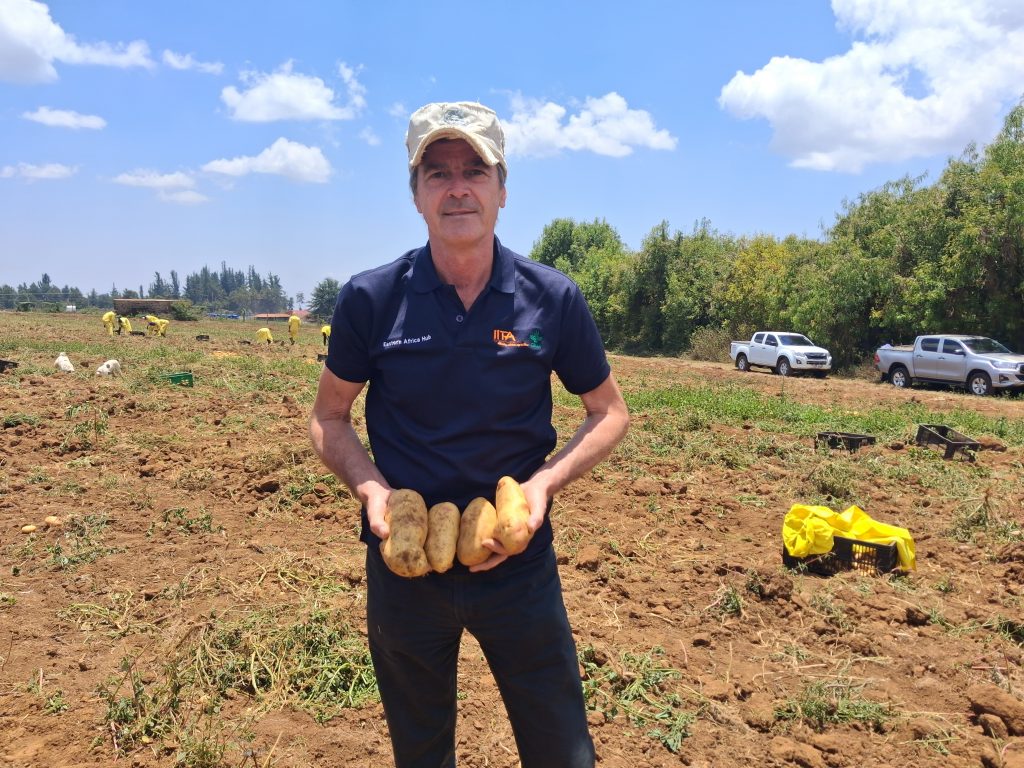
It is against this background, that IITA and its partners have introduced two new varieties, Glen and Malaika, that are resistant to PCN. Already, both varieties have been enlisted in Kenya’s National Variety List.
Scientists from the James Hutton Institute in Scotland introduced the two varieties. The Institute is a leading global institution in potato breeding and research. The collaboration included the University of St Andrews, IITA, the International Potato Center (CIP), and the International Centre of Insect Physiology and Ecology (icipe), as well as the Kenya Plant Health Inspectorate Service (KEPHIS) and Seeds2B Africa.
Besides being PCN resistant, the two new varieties have traits that are prioritized by smallholder farmers. They have low dormancy (the length of time before they start to develop sprouts) which can be replanted quickly after harvest and are fast cooking to reduce fuel use.
Prof. John Jones, Senior scientist, the Hutton lead in the project, notes that the two varieties came from a breeding programme in Scotland that was run by the James Hutton Institute and Greenvale AP.
“They did the cross-breeding and produced different varieties. Some of them were suitable for commercialization in Europe, but 12 varieties had very low dormancy, which were not suitable for Europe because we need to store our potatoes over winter,” Prof. Jones stated.
“We knew what growers wanted in Kenya in terms of dormancy and cooking time and flavor and we thought they would be ideal. Not only do they have these properties, but they are also resistant to PCN, which has become prevalent in Kenya.”
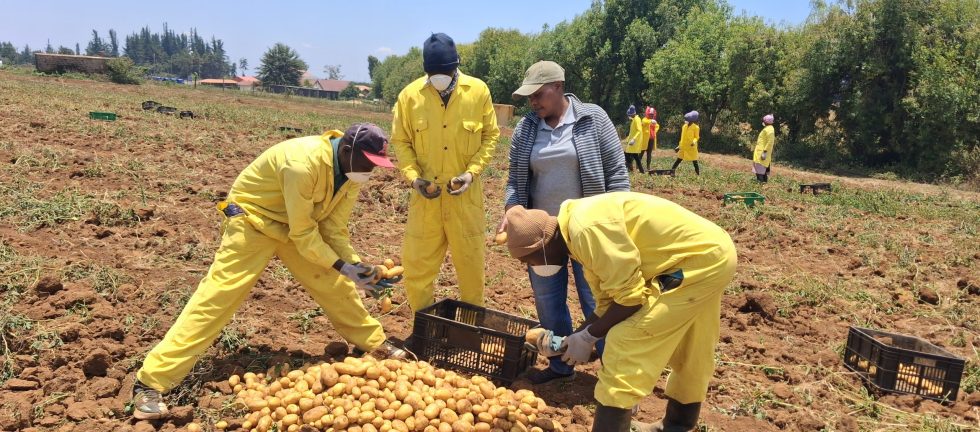
The twelve different varieties were brought to Kenya and field trials were conducted. Working with farmers, including youths and women groups, they also carried out taste and grower tests. From these, Glen and Malaika were selected.
“Our objective during the trials was to select a variety that is going to give more choices to farmers in terms of PCN resistance and dormancy. From the trials, we were also able to collect data in regard to dry matter. These varieties performed quite well,” said Manasseh Ndung’u, Seed research and development manager, Seeds2B Africa.
“While the local dominant variety, Shangi, had an average dry matter of 18, both Glen and Malaika had a high of 21 and 22.”
For processors, dry matter is an issue of concern. Varieties with high dry matter absorb less oil and produce a desired texture. For making chips, the dry matter should be above 18, while for crisps should be about 22 and above.
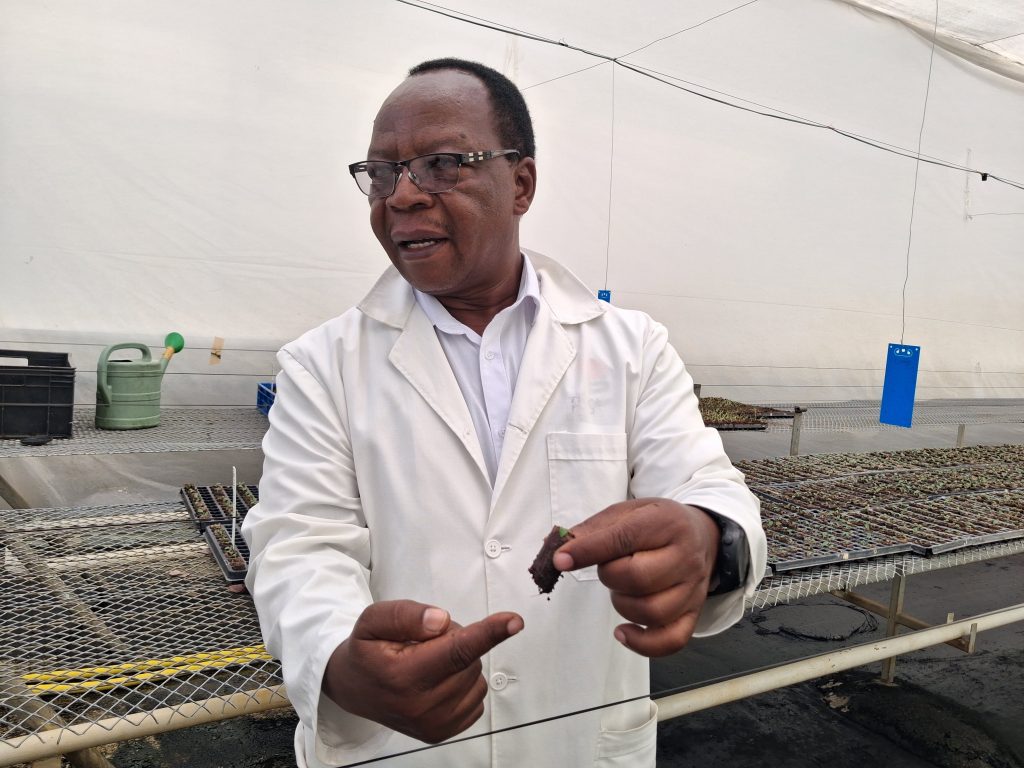
According to Richard Siele, Manager in charge of young plants, Stockman Limited, who was in charge of producing rooted apical cuttings for use in the field trials, the performance of the two varieties was good compared to the existing varieties.
Siele notes that with the other varieties, there are a few rejections often characterized by some discoloration or slight rot. However, with Glen and Malaika, there was no rejection. The two varieties were 100% clean, with no infections or contamination witnessed.
“Production was also high. The other existing potato varieties produce an average of eight tubers per plant when we put them in the bucket. But the new varieties can produce even higher than twelve tubers,” he stated.
“Besides being PCN resistant, this is a good indicator that when it goes to the farmers’ fields and is well managed, the production is higher compared to other varieties.”
Jesse Kamutu, a farmer and seed producer in Kinangop, Nyandarua county, observes that the new varieties are first producers. Within one and a half months, the new varieties have produced tubers yet for the local dominant variety, it takes two and a half months for them to start producing.
Having experienced firsthand the devastating effects of PCN on his yields, from an average of 80 bags (100kgs each) to 30 bags an acre, Kamutu assures farmers that from the field trials carried out on his farm, the two varieties “promise good quality and quantity, hence value for money.”
With the acquisition of clean quality seeds posing a serious challenge among smallholder farmers, already efforts are underway including partnership with Kisima Seeds (a leading local seed company) and other local seed producers to ensure that farmers receive good quality certified Glen and Malaika seeds.